
Programmatic advertising works through automated, real-time auctions: when someone loads a page, app, or stream, software on the advertiser’s side, a demand side platform (DSP), evaluates the available ad space, checks it against the campaign’s audience and budget, and bids on it. The winning ad appears in the fraction of a second it takes the page to load, and results feed back into the system so budget shifts toward what performs. This post walks through the ecosystem that makes that buying possible.
In previous posts we discussed the History of Demand Side Platforms and the Benefits Of Demand Side Platforms. These are the tools advertisers and their agencies use to activate and optimize advertising campaigns.
What Is Programmatic Advertising?
Programmatic advertising is the use of data, software and automation to make smart advertising decisions. That’s the simplest definition of a very loaded term, and because the term is so loaded, many people in the industry (us included) often skip it and just name the channels: banners, video, connected TV, audio, social.
How Programmatic Advertising Works
Let’s dive into the details. When digital advertising is bought today there is an ecosystem of connections that make the ad buying possible. For example, I can go to a platform like The Trade Desk to buy an ad on a publisher like Yahoo or Food Network. For me to make that transaction I will use data from a company, possibly Mastercard or Nielsen. The ad will run through an intermediary, called an ad exchange or supply side platform, and the ad will run on the sites I mentioned. The programmatic ecosystem is that infrastructure, and allows those connections to happen with virtually infinite combinations.
If you want to see the companies that comprise the programmatic ecosystem look at this Lumascape. Luma Partners is a firm run by Terence Kawaja. They are a strategic advisory firm that helps companies with, among other things, mergers and acquisitions. For example, they helped facilitate the transaction between Foursquare and Factual.
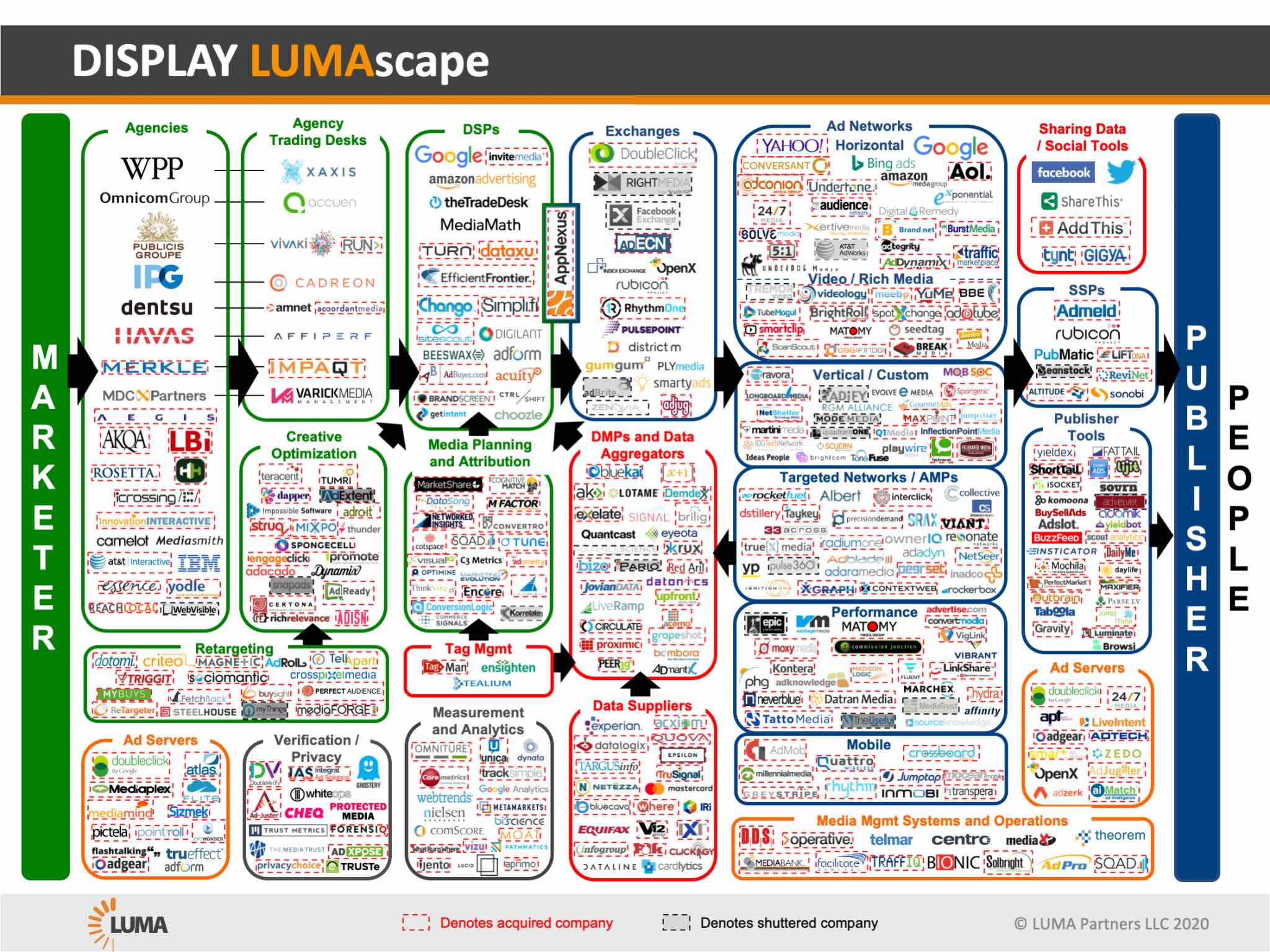
I counted the logos. There are over 300 logos on this sheet representing companies that make up this ecosystem. Certainly there are mergers and acquisitions happening all the time, so the true count of companies participating in the programmatic ecosystem is always fluctuating.
What you’ll see on this chart are a whole slew of company types. I’ll call some out. You have advertising agencies, which do your typical work of setting up strategies, defining audiences, developing creative, and buying advertising space. You then have trading desks. These are companies whose job is to be hands on keyboard for the tools that help advertisers buy inventory. These are the DSPs, which we covered. I’ll stop right here, and say that if you are reading this and you want to know more about how to build a trading desk you can check out our 2020 Advertiser Trading Desk Success Guide. It’s over 30 pages and breaks down the process to build an agency trading desk into five steps.
We are a trading desk, although you won’t often hear us talk about ourselves with that term, because unless you are part of the programmatic ecosystem, that term, also, just like the term programmatic, is loaded and causes too much confusion.
You’ll see the ad exchanges, ad networks, supply side platforms, social platforms, ad servers, data suppliers, dynamic creative tools, and whole slew of other companies that are part of this ecosystem.
What makes this ecosystem particularly durable is the fact that companies can build on top of it. For example, if I want to start selling data, there are companies that exist that allow me to use their infrastructure to go from having a product idea, to actually selling that data product. I’m not saying the process is easy, but I am saying that a new data company doesn’t have to build all the connections by hand. What this also does is lower the barrier to entry for companies who have new and innovative products, thereby increasing competition, and providing opportunities for all manner of entrepreneurs.
So, to recap, the programmatic ecosystem really creates a pathway for advertisers large and small to reach consumers. If you want the full recap of advertiser benefits watch the video called 8 DSP Benefits. This write-up reviews the benefits to advertisers.
There are different value propositions that publishers are looking for. And, since I haven’t spent any substantial time working for publishers in my career I can’t give you too much insight. What I will say is that supply side platforms, or SSPs, are designed to give publishers an opportunity to maximize their revenue through the benefit of maximizing the amount of sold inventory, maximizing the CPM that advertisers pay for that inventory, and using data to understand the best combination of those two factors. This really comes back to supply and demand economics. Price the ad inventory too high and there will be a fewer buyers, therefore diminishing overall revenue. Price the ad inventory too low, and there will be many buyers, but overall revenue diminishes because buyers aren’t paying enough on a per impression basis. Find the right middle ground, and you maximize your revenue.
Three Overall Uses For Programmatic
1. For Advertisers
There are three overall uses for the programmatic ecosystem. The one that’s most interesting to me, considering that we sit on the demand side, or the advertiser’s side, is the opportunity to buy ad inventory with precision, scale, labor efficiency, and campaign effectiveness.
Remember that the overwhelming majority of display advertising is transacted through the programmatic ecosystem, so chances are, if you are running digital advertising today you are buying through the programmatic ecosystem, including with ads on social platforms. In fact, if you don’t have access to one of the major DSPs, first of all you should reach out to us and we can help you there. In some cases our business acts as a white label for other advertising companies. The advertiser doesn’t know that BrillMedia.co exists, but the agency is using us to power their digital ad buying. But, if you don’t use these tools, and you are buying ads through Facebook, for example, you are a participant in the programmatic ecosystem. The reason I bring this up is because Facebook is a really powerful demand side platform. If you want to know the functionality of demand side platforms, you see a great example of it in Facebook. Another example of it is Google Ads. Both of these platform use data and automation and allow businesses to reach consumers with ads. Data is used for targeting. Reporting is used to gather intelligence and setup optimization decisions. Inventory is readily available in the platform.
2. For Inventory Owners
The second overall use is for ad inventory owners to monetize. With the exception of some trade publications, like DentalTown.com, for example, most publications are available through the programmatic ecosystem. Publications use the ecosystem because that is where the bulk of ad dollars flow, which means a publisher that doesn’t participate is closed off from most of the marketplace. So, it’s part of the deal: if you want to be a seller of ad inventory today it’s a safe bet that you’ll probably be in the programmatic ecosystem. The trade publications don’t participate because they have a very small reader base who are in a specific vertical, like dentistry, and the advertisers go direct to them to buy ad space. Because of the specialty nature of the publication, they can charge higher overall rates than they’d get on the programmatic ecosystem (although there are ways to maintain those rates), and advertisers work directly with the publisher in the same way that advertising happened in 2005.
3. The Buy Side And Sell Side Services
The third group the programmatic ecosystem services is the intermediary businesses that support buyers or sellers with tools that make the job easier. For example, a company called Adacado makes dynamic ad creative happen with simple tools that are designed for small businesses. Flash Talking and Celtra make dynamic creative targeting happen for larger enterprises. But, neither of these tools would have an easy go of it if the pathways were not already laid in the programmatic ecosystem. Programmatic is like the network of roads and bridges we have in the US. Anyone can use them, taxes pay for their creation and upkeep, and anyone can build a hotel, home, or hospital along the roadways. Without the roadways the buildings would be kind of out in the middle of nowhere, with no good way for people to get there. So, the builder would have to then build their own roads, making it unnecessarily costly just to get people to a hotel, home, or hospital.
Programmatic is the standardized connection between these hundreds of companies that makes the business run smoothly, and it now powers the majority of US digital ad spending.
The final part of this write-up will talk about why we don’t use the jargon around programmatic, and why in general across the industry it’s going away.
The simplest explanation is that it’s confusing, takes too much time to explain, and you’re never really sure if the person you’re talking to understands programmatic the same way you do. This happens at all levels of the business. If I talk about programmatic I’m including Facebook. If I propose running a programmatic campaign, which is everything we do, I may mean banners and Facebook ads. My client may take programmatic to be banners and inventory outside of the social platforms. So, right there we have miscommunication. So, when we talk about our business we talk with more specificity. If we want to run campaigns we talk about banners, Facebook, Instagram, and video ads.
When I started developing our product base for our business early on, going as far back as 2013, I remember talking to people about programmatic, and seeing that gloss come over the other person’s eyes. It’s hard to sell programmatic. It’s much easier to sell banners, Facebook, video, and hyperlocal. In the first few years I found that people responded well to the term hyperlocal, so for many years we prominently talked about our capabilities around hyperlocal advertising.
Economics
So, in aggregate, programmatic became the de facto way of buying digital advertising, and not just across what most people consider digital media. All of this also applies to digital signs, digital audio, and connected TV ads. The numbers below come from eMarketer’s 2020 forecasts, when this post was first written, worth keeping as a snapshot of the moment programmatic crossed the halfway mark of all US ad spending.
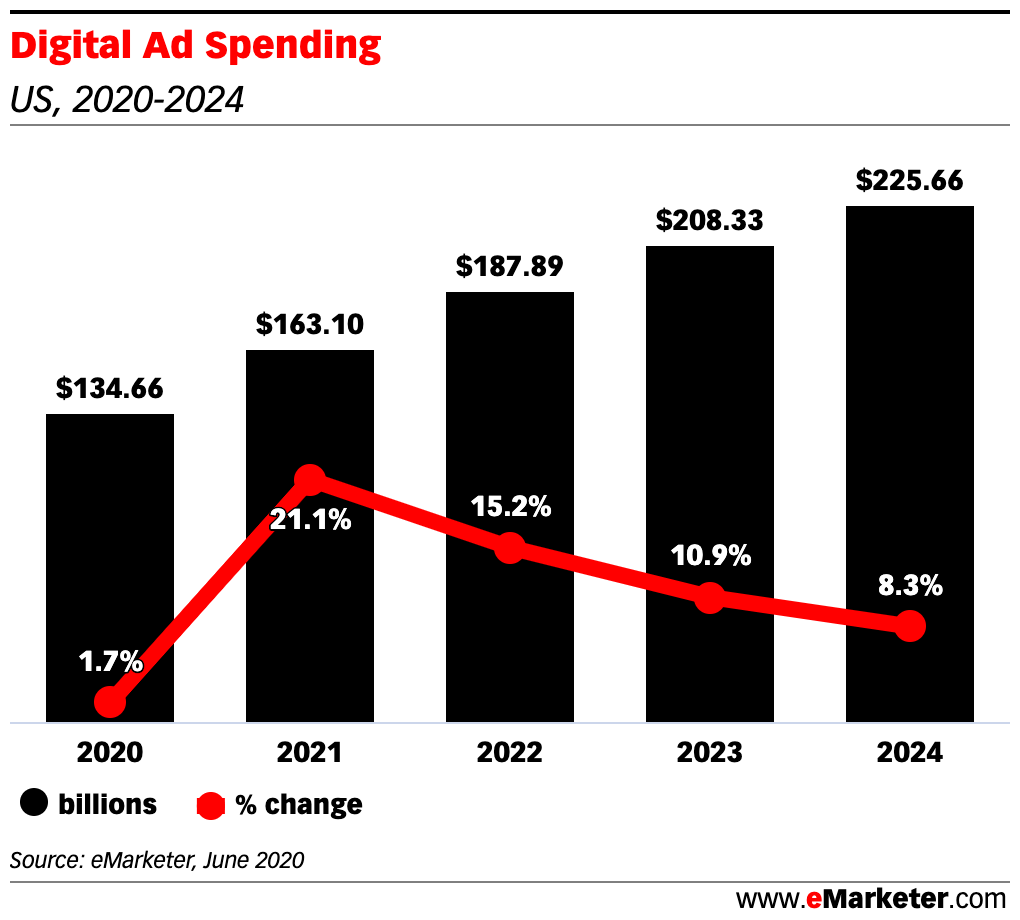
Back in 2020, eMarketer projected all US advertising at $225B, with $134B of that going to digital media. That was as of June 2020, with some Coronavirus slowdown taken into account, and it put digital media at 59% of all US ad spending that year.
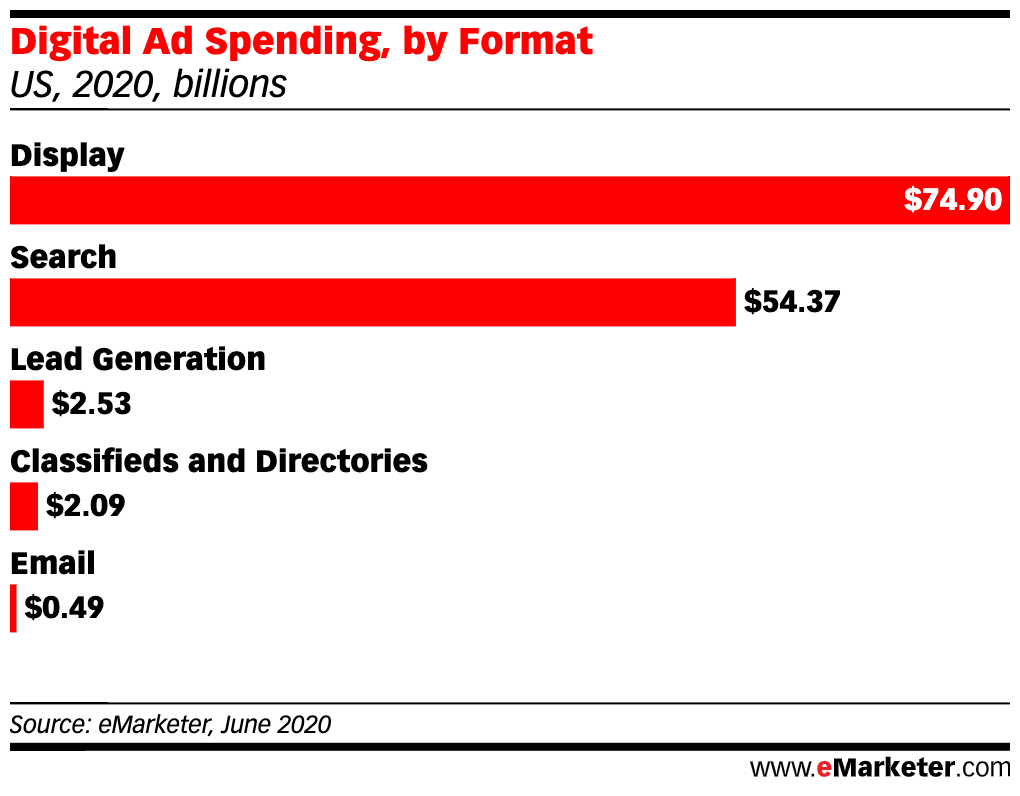
In that 2020 breakdown, digital ad spending had two main buckets: search ($54B) and display ($74B). Search ads can be bought in the same way banners are, through self-service, hands-on-keyboard software. Just log in and you can buy search ads. Search was programmatic before it was called programmatic: data, software, and automation. At the time, programmatic was 85% of display advertising, or $63B. That added up to $117B in US advertising bought through a programmatic framework, 52% of all US ad spending in 2020, the year automation crossed the halfway mark.
That trend played out the way the forecasts suggested. Traditional TV ad spending, once the dominant medium in the US, kept declining as audiences moved to streaming, while digital kept growing year after year. The line item the 2020 charts treated as emerging, connected TV, is now a mainstream channel, bought programmatically alongside display, audio, and digital out-of-home.
At this point, with connected TV, out-of-home, and digital audio all transacted through programmatic tools, well more than half of US advertising is bought programmatically. I argue that it’s reasonable to say that programmatic is synonymous with digital advertising, which is quickly becoming just advertising.
Programmatic is important, the term is going away, and the mechanics of the programmatic marketplace continue to power the overall US advertising ecosystem.
What Has Changed Since This Was Written (2026 Update)
The mechanics above still describe how programmatic works. A few things around them have shifted:
- The cookie saga ended in a shrug. For years the industry braced for Google to remove third-party cookies from Chrome. In the end Google reversed course on full deprecation and left the choice to users. Targeting today runs on a blend of cookies, publisher first-party data, contextual signals, and newer identity frameworks, no single replacement won.
- The ecosystem consolidated. Some of the DSPs named in the original post, like MediaMath, no longer exist. The buying power concentrated around a smaller set of major platforms: The Trade Desk, Google’s Display & Video 360, Amazon DSP, and a handful of specialists.
- Connected TV and retail media went mainstream. Streaming TV ads and retailer ad networks (Amazon, Walmart, and others) are now standard line items on media plans, not experiments, and both are bought programmatically.
- AI-driven bidding became table stakes. Every serious platform now optimizes bids with machine learning. The differentiator is no longer the algorithm; it’s the strategy, data, and creative you feed it.
If you want this machinery working for your business without becoming a programmatic expert yourself, that is exactly what a programmatic advertising agency does, and it’s worth understanding why demand side platforms are the right way to buy before you talk to any vendor.